
How to Declutter Your Home Using the 20/20 Rule
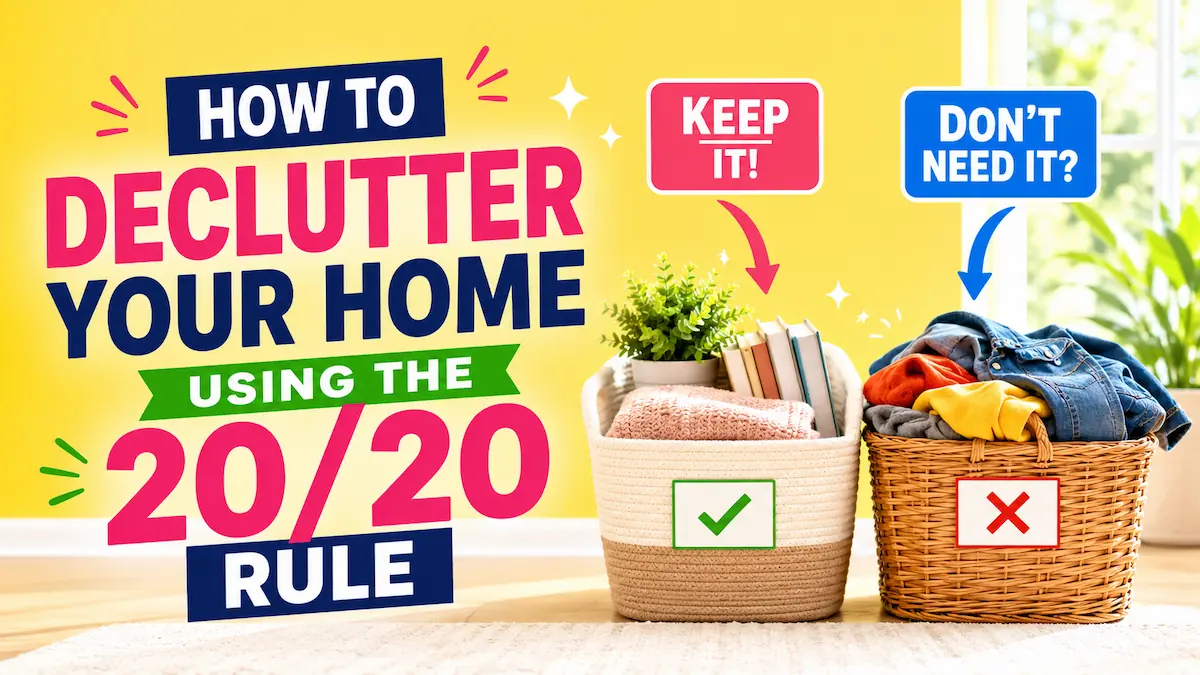
The hardest part of decluttering isn’t the physical work. You know that already. It’s that one nagging thought that stops you cold every single time you pick something up: what if I need this someday?
That thought has filled more closets, junk drawers, and garages than anything else in America. And for years, it kept me holding onto things I hadn’t touched in half a decade — spare cables, a bread maker I used twice, four sets of batteries that may or may not be dead.
Then I came across the 20/20 rule. And it genuinely changed the way I approach letting things go.
This article covers exactly what the rule is, the psychology that makes it work, how to apply it room by room, and what to actually do with things once you decide to move them out. No, you don’t have to become a minimalist. You just need two questions.
What Is the 20/20 Rule for Decluttering?
The 20/20 rule was created by Joshua Fields Millburn and Ryan Nicodemus, better known as The Minimalists, and it’s deceptively simple.
Here it is: if an item can be replaced for under $20 and found again within 20 minutes of your home, you don’t need to keep it “just in case.”
That’s it. Two numbers. Two questions. You hold up an item, you ask both questions, and if the answer to both is yes, it goes.
The reason it works isn’t the dollar amount. It’s that it forces you to ask a concrete, answerable question instead of an emotional one. “Will I ever need this?” is impossible to answer. “Can I buy a replacement for $20 at Target?” That one you can actually answer right now.
If you live somewhere like New York City or San Francisco where the cost of living is higher, feel free to bump the threshold to $30 or $40. The specific number matters less than the habit of asking.
Why the 20/20 Rule Actually Works (The Psychology)
Here’s what most decluttering guides won’t tell you: holding onto things you never use isn’t laziness. It’s your brain doing exactly what it was designed to do.
Behavioral economist Daniel Kahneman spent decades studying how humans make decisions about loss. His research found that people feel the pain of losing something roughly twice as strongly as the pleasure of gaining something of equal value. That’s why letting go of a $15 spatula you haven’t cooked with in three years feels harder than it logically should. Your brain is treating it like a loss, not a decision.
The “just in case” mindset feeds directly into this. We consistently overestimate how often we’ll need things we rarely touch. A study from UCLA’s Center on Everyday Lives of Families found that the average American home contains around 300,000 items. Most of them are used infrequently or not at all. We’re surrounded by contingency plans for scenarios that almost never arrive.
What the 20/20 rule does cleverly is shift the question away from emotional territory. Instead of “but what if I need it,” you’re asking “how much does it actually cost to replace it.” The moment you realize the answer is $12 at Walmart and a five-minute drive, the grip loosens.
There’s also a health angle worth mentioning. Research published in the Personality and Social Psychology Bulletin found that people who described their homes as cluttered had higher levels of cortisol — the stress hormone — throughout the day. Cluttered spaces create low-grade, constant stress that most of us don’t consciously register until it’s gone. Clearing even one room tends to feel disproportionately good, and now you know why.
How to Use the 20/20 Rule to Declutter Your Home (Step by Step)
Don’t start with the whole house. That’s the mistake almost everyone makes — they get ambitious, pull everything out of every closet, and three hours later they’re sitting on the floor surrounded by piles, exhausted, and shoving it all back in.
Start with one drawer. Or one shelf. Finishing something small builds real momentum.
Step 1: Pick one contained space. A kitchen junk drawer, the cabinet under the bathroom sink, a single shelf in the garage. Small and winnable.
Step 2: Pick up each item physically. Don’t just scan with your eyes. Hold it. Touching an object engages a different part of your brain than looking at it — it makes the decision feel real rather than theoretical.
Step 3: Ask the two questions out loud. Can I replace this for under $20? Can I find a replacement within 20 minutes of my home? If yes to both, it qualifies for removal. If either answer is no, it stays — no guilt required.
Step 4: Make three piles only. Keep, Donate/Sell, and Trash. Do not make a “maybe” pile. A maybe pile is just a second cluttered space with a polite label on it.
Step 5: Act on the donate pile the same day. Put the bag or box directly into your car before you go to bed. The longer it sits in a corner, the more likely individual items start migrating back onto shelves and into drawers with very convincing excuses attached.
One practical add-on: set a 20-minute timer per session. It sounds too short, but short focused sessions beat three-hour marathons that end in decision fatigue. You’ll make better choices in 20 minutes of genuine focus than in two hours of slowly losing your will to live.
Applying the 20/20 Rule Room by Room
Every room in a typical American home has its own category of clutter. Here’s where to focus.
Kitchen: Go after duplicate gadgets first — three spatulas when you use one, two can openers, four wooden spoons. Then expired pantry items, novelty mugs from forgotten events, and specialty appliances that only do one thing (I’m looking at you, electric quesadilla maker). Virtually all of it passes the 20/20 test. A new spatula is $8. A replacement can opener is $11.
Bedroom closet: Anything not worn in the past 12 months is the starting point. Layer the 20/20 test on top — if you haven’t worn it in a year AND you could replace it for under $20, it’s an easy decision. Duplicate shoes, old bedding sets, clothes in sizes you’re neither currently wearing nor realistically approaching, all belong in this category.
Bathroom: Expired medications, sample-size toiletries from hotel stays two years ago, duplicate hair tools, products you bought once and hated. One important note on medications: don’t throw them in the trash or flush them. The DEA runs a National Prescription Drug Take-Back program — search “DEA drug take-back near me” to find a drop-off location. This is a free service and takes about two minutes.
Garage and storage areas: This is where “just in case” thinking goes to reach its fullest expression. Broken tools waiting to be fixed (that never get fixed), half-empty paint cans from a 2019 renovation, duplicate holiday decorations, sports equipment for sports no one in the household plays anymore. Be ruthless here. The garage is not a museum for objects that used to be useful.
Home office and junk drawer: The easiest win in the house. Old charging cables for devices you no longer own, pens that don’t work, instruction manuals for appliances long since replaced, expired coupons, mystery keys. Ninety percent of junk drawer contents will pass the 20/20 test immediately. This is the best room to start in if you want fast, visible results.
What to Do With Items Once You Decide to Let Them Go
Decluttering stalls when people don’t have a clear answer to “okay, but now what.”
Donate: Goodwill and Salvation Army accept most household goods and clothing. For items in excellent condition, local Buy Nothing Facebook Groups are worth trying — someone in your neighborhood probably wants exactly what you’re letting go of, and it avoids the drive entirely.
Sell: Facebook Marketplace and OfferUp work well for furniture and larger items. ThredUp and Poshmark are better for clothes. Electronics and collectibles tend to do better on eBay where buyers are searching specifically.
Recycle: Electronics — Best Buy has free drop-off recycling for most devices and cables, no purchase required. Old clothing scraps and unusable textiles — H&M stores have recycling bins near the entrance. Batteries — the Call2Recycle locator at call2recycle.org finds the nearest drop-off, often a hardware store.
Trash: Last resort, but sometimes the right answer. A useful reframe: if something can’t be donated, sold, or recycled, its useful life is genuinely over. Holding it in your home doesn’t preserve its value — it just transfers the burden to you.
3 Common Myths About the 20/20 Decluttering Rule
Myth 1: You have to be a minimalist to use it. Not even close. The 20/20 rule is a decision-making tool, not a lifestyle commitment. You can use it on one junk drawer, feel the difference, and stop there. Nobody is requiring you to own 33 possessions and live in a white room.
Myth 2: It doesn’t apply to sentimental items. Correct — and this is by design. The rule was explicitly built for replaceable items. Your grandmother’s jewelry, your kids’ first drawings, meaningful gifts — none of these belong in a 20/20 cost analysis. Sentimental items deserve their own thoughtful approach, separate from the practical clutter question.
Myth 3: Using it means throwing everything away. No. Items that qualify under the 20/20 rule go to someone who can actually use them — they get donated, sold, or recycled. Letting something go isn’t wasteful. Keeping something you never use while someone else could benefit from it is the more honest definition of waste.
Start With One Drawer
The 20/20 rule comes down to three things: a two-question test that defeats “just in case” thinking, a willingness to start small rather than wait until you have a whole weekend free, and the understanding that a clutter-free home isn’t an empty home — it’s one where everything that’s there actually earns its spot.
You don’t need a new year, a new motivation, or a free Saturday. Right now, open your junk drawer. Pick up the first five things in it. Ask both questions about each one. You’ll find the process starts itself.
Frequently Asked Questions
What is the 20/20 rule for decluttering?
The 20/20 rule, created by The Minimalists, is a simple test for “just in case” items: if something can be replaced for under $20 and found within 20 minutes of your home, you don’t need to keep it. The rule helps break emotional attachment to replaceable objects by reframing the decision around concrete cost.
Does the 20/20 rule work for sentimental items?
No, and it isn’t meant to. The rule specifically targets replaceable household items — not heirlooms, photographs, or gifts with emotional significance. For sentimental belongings, a separate approach works better: a designated “memory box” with a firm size limit (one box, not five).
How long does it take to declutter a house using this method?
Think of it as a practice rather than a project. At 20–30 minutes per session, two or three times a week, most people see a significant difference in four to six weeks. Trying to do it all in a weekend usually results in decision fatigue and stuff back in the closet by Sunday night.
What if I get rid of something and regret it?
It happens rarely, and when it does, the cost is usually the $20 or less you already accounted for. More importantly, research consistently shows people overestimate how often they’ll regret decluttering and underestimate how much lighter they’ll feel after. The mental load of managing clutter adds up quietly — you only notice it when it’s gone.
Can I use the 20/20 rule for kids’ stuff?
Yes, with some adjustments. Involve older kids directly — children who participate in the decision tend to accept it far better than those who come home to find things missing. Focus the 20/20 filter on broken toys, outgrown clothes, and duplicates. Let kids make the final call on items within that shortlist.
